Powered By Blogger
Showing posts with label berlin. Show all posts

Wednesday, March 07, 2012

Do Film Festivals Matter Where Oscars Are Concerned?


When it comes to film festivals, the question on the street this year is, "Do film festivals really matter where the Oscars are concerned?" My answer is that some do, some don't, and some count more than others.

However, keep in mind that these are no longer "film" festivals. Oh, yes, film festivals is a great alliteration that trips off the tongue, but the title "film festivals" denoting a showcase for new motion pictures must go. Why? Because film is the material and process once used to make motion pictures and, except for a few third world countries, film is no longer used to make motion pictures, moving pictures, movies, cinema, cine, etc. Digital is the new medium of choice, and 3D is rising in popularity as digital techniques for it improve.

For instance, I attended and taught in the Film School at the University of Southern California (History and Criticism), but that school no longer exists. Don't panic, it is now known as the USC School of Cinematic Arts, and my field is now known as Cinematic Critical Studies. The School of Cinematic Arts at USC, now has it's own building, the George Lucas Building, SCA 108, which also contains the The Ray Stark Family Theatre, all at 900 W. 34th Street, Los Angeles, CA 90007.

So, the times have changed, and are constantly changing. Therefore, are film festivals still relevant in the Race for the Oscars in spite of the gigantic procreation of them in every town and hamlet, and their rapidly deteriorating event name?

That depends on the festival. Here are the top five that should be followed by everyone from the occasional movie goer to those studying, teaching, or writing about Cinematic Critical Studies:

1. Berlin International Film Festival, a.k.a., Berlinale, is the first festival out of the gate in Europe, held in February. In 2011, it had one big winner in its lineup, the foreign language film Oscar winner, A Separation (Iran), directed by Asghar Farhadi, won the festival's Golden Bear. At the 84th Academy Awards on February 26, three huge Oscars were awarded to Berlinale films and guests.

 A Separation's Oscar win, plus actress Meryl Streep's, Honorary Golden Bear for Lifetime Achievement at the Berlinale 2012, and her Oscar win for best performance by an Actress in a Leading Role for The Iron Lady, directed by Phyllida Loyd, gave the Berlinale big bragging rights.

It was Streep’s 17th nomination and third Oscar. In addition, the Oscar for makeup went to her long-time make up artists, Mark Coulier and J. Roy Helland for their work in The Iron Lady, which was presented in the Berlinale Special 2012.

In all, eight films that participated in the Berlinale 2011 and 2012 were nominated by the Academy of Motion Picture Arts and Sciences in eleven different categories. More on the Berlinale below.

2. The Cannes Film Festival's 2011 lineup had six wins, 19 nominations. It screened the big Oscar winner, The Artist, as well as: The Tree of life, Midnight in Paris, Drive and the Israeli documentary, Footnote.


3. New York Film Festival: Five wins, 13 nominations. A year after nabbing the world premiere of the phenomenal, The Social Network, it chose to premiere a motion picture that was not yet completed at the time of the festival, so it featured a work-in-progress special screening at the festival for the second biggest winner of 2011, Hugo directed by indomitable Martin Scorsese, as well as the movie that probably had the most photographs published last year, My Week With Marilyn.

People wouldn't have guessed it then, but Hugo would end up getting five Oscars from 11 nominations. My Week With Marilyn received two nominations.

I give the New York festival extra points because it had the guts to open with Roman Polanski's Carnage, plus the gala screenings featured David Cronenberg's A Dangerous Method, and Pedro Almodóvar's newest, The Skin I Live In. As for that last one, the Spanish Film Academy should have, but did not submit it for the Best Foreign Language Film Oscar. Talk about a snub. That was bigger than any of the so-called 2011 "Oscar snubs."

4. Telluride Film Festival: One win, 10 nominations. Telluride had The King's Speech and 127 Hours the year before, but only one debut at Telluride that had any real Oscar traction in 2011. That was Alexander Payne's The Descendants. It received five nominations but only a single win at the 2012 Oscars, for best adapted screenplay.

5. Toronto International Film Festival: One win, nine nominations. The Toronto Peoples Choice Award had been spot-on picking the best picture at the Oscars with The King's Speech, Precious and Slumdog Millionaire, but the crystal ball went dark in 2011 when they chose Nadine Labaki's Lebansese movie, Where Do We Go Now? It went on to win nothing. However, Moneyball, Beginners, Anonymous,
and Paradise Lost 3 went on to be nominated, along with Brad Pitt and Christopher Plummer for their acting chops. Plummer won best supporting actor but Pitt won nothing.

Runner Up: SXSW Film Festival: One win, three nominations. This festival is not known for scoring Oscar nominations or winners but this year it got lucky with two winners, Bridesmaids and the documentary feature winner, Undefeated. So, a salute to one of my favorite U.S. festivals.

BERLIN: 62nd Berlinale 2012,  February 9 - 19.

PRIZES OF THE INTERNATIONAL JURY:

GOLDEN BEAR FOR THE BEST FILM - Caesar Must Die (Cesare deve morire) by Paolo & Vittorio Taviani;

Will this one be big in 2012?
Caesar Must Die
 JURY GRAND PRIX-SILVER BEAR - Just The Wind (Csak a szél) by Bence Fliegauf;

SILVER BEAR FOR BEST DIRECTOR - Christian Petzold for Barbara;

SILVER BEAR FOR BEST ACTRESS - Rachel Mwanza in War Witch (Rebelle) by Kim Nguyen;

SILVER BEAR FOR BEST ACTOR - Mikkel Boe Følsgaard in A Royal Afair (En Kongelig Affære) by Nikolaj Arcel;

SILVER BEAR FOR AN OUTSTANDING ARTISTIC CONTRIBUTION -
Lutz Reitemeier for the photography in White Deer Plain (Bai lu yuan)  by Wang Quan'an;

SILVER BEAR FOR THE BEST SCRIPT - Nikolaj Arcel, Rasmus Heisterberg for A Royal Affair (En Kongelig Affære) by Nikolaj Arcel;

ALFRED BAUER PRIZE, awarded in memory of the Festival founder, for a work of particular innovation - Tabu by Miguel Gomes;

SPECIAL AWARD-SILVER BEAR - Sister (L'enfant d'en haut) by Ursula Meier.

The members of the 2012 International Jury, Mike Leigh (President), Anton Corbijn, Asghar Farhadi, Charlotte Gainsbourg, Jake Gyllenhaal, François Ozon, Boualem Sansal and Barbara Sukowa.


Monday, January 02, 2012

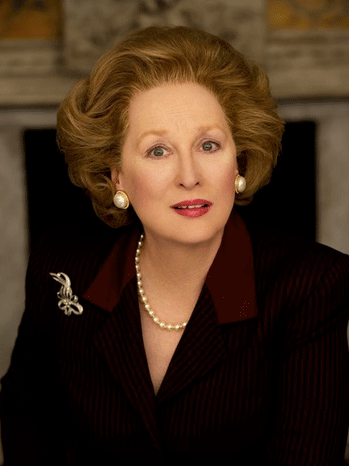
Meryl Streep, Star of 'The Iron Lady', Racks Up Awards

Meryl Streep as Thatche
 Actress Meryl Streeps' new starer, The Iron Lady, premiered Tuesday, December 13, at the Ziegfeld Theater, NYC, to much praise, especially for the actress on the verge of assuming the title of the current gran dame of Hollywood actresses. Streep, wearing a big-hair red wig, remarkably resembles the former U.K. Prime Minister Margaret Thatcher, as does Streep's voice. Oscar buzz for Meryl Streep has been growing for almost a month, and The Iron Lady, scheduled to open January 13, hasn't opened at the time of this post.

Shortly after the movie's premiere, Streep received the Kennedy Center Honor for her achievements in acting and humanitarian causes. In October, she won the New York Film Critics Circle Award for her role in
The Iron Lady, while their best picture award went to the black and white move, The Artist.

Streep was recently nominated for a best actress Screen Actors Guild (SAG) award, and a Golden Globe in the same category. Now comes word she will receive an honorary life-time achievement Golden Bear at the Berlin International Film Festival, which will run February 9-19 in Berlin, Germany. The 69th annual Golden Globes will be broadcast live in HD on NBC Sunday, January 15, 2012, and the 18th Annual Screen Actors Guild Awards are scheduled for Sunday, January 29, 2012, at the Los Angeles Shrine Exposition Center.

The Berlin International Film Festival presentation ceremony for Streep is scheduled for February 14, and, of course, a screening of
The Iron Lady will follow. As a further homage to Streep, the festival will also screen some of her best-known films, among them: Kramer vs. Kramer, Sophie's Choice, Out of Africa and The Bridges of Madison County. Which is your favorite among these? For more on the tribute, click the title of this post.

And, there are more honors for Streep, currently 62. She is on the cover of the January issue of Vogue Magazine. The headline?  "Meryl Streep: Force of Nature," a fitting title since she is a shareholder in the Community-Supported Agriculture (CSA) organization, a.k.a. Local Harvest, and has been working for safe, organic and ecologically sustainable food for more than a decade.

She is also a supporter of the campaign for a National Women’s History Museum in Washington, D.C.  So far, this exists as a virtual entity with a nice Web site (nwhm.org), but campaigners have been working to get an actual, physical museum “Right Here. Right Now” (as their literature puts it) on a property on, or adjacent to, the National Mall.

Since this is federal land, Congress must pass legislation to authorize the purchase, even though the museum will not cost the taxpayers anything, because it will be privately funded. Of course, Congress, especially the House, does as little as possible, so the project remains on hold.

I agree with Streep and the others. It's time the contribution of women to the U.S.A. had a "residence" on the National Mall along with the gents.

According to the IMDb, Meryl Streep has been nominated for an Academy Award 16 times. She has won only twice: Kramer vs. Kramer (1979) and Sophie's Choice (1982). It's time she added a third statuette to her fireplace mantel before all the Academy will present her is an honorary Oscar for her life's work. 

You go, girl!

The 84th Academy Awards nominations will be announced live on Tuesday, January 24, 2012, at 5:30 a.m. PST in the Academy's Samuel Goldwyn Theater.


Academy Awards for outstanding film achievements of 2011 will be presented on Sunday, February 26, 2012, at the Kodak Theatre at Hollywood and Highland Center, and televised live at 7 p.m. EST/4 p.m. PST by the ABC Television Network. The Oscar presentation also will be televised live in more than 225 countries worldwide.

Sunday, May 15, 2011

Arab Cinema Finds an Niche in Western Film Festivals

In honor of Egyptian courage and expression of freedom, the International Cannes Film Festival will host Egypt film and filmmakers at the 64th International Film Festival as the first ever guest country at the Cannes IFF, May 11 - 22, 2011.

The Festival will also honor late Egyptian directing legend Youssef Chahine and screen 18 Jours (18 DAYS), as well as a grouping of short films by several Egyptian directors filmed during the nation's January 25th revolution. Profits from the films will go toward political and public education programs in rural Egypt. O.K., I'm down with the funds for rural public education programs but a bit skeptical about the motives of political education. That is very vague.

The third Arab Film Festival Berlin, organized by Cinemaiat - Friends of the Arabic Cinematheque Association, will be held from November 2 to 10 this year. The festival's main program will present recent works by Arab filmmakers, and this year's special focus section on humor will present films of varied lengths and production dates.

Feature films, documentaries and shorts made in the last three years are eligible for Berlin, as long as they are directed or produced by an Arab filmmaker/production company, or present an issue closely connected to the Arab world. The submission deadline is June 30, 2011.

The Fourth Gulf Film Festival (GFF) at Dubai, drew to a close April 20th and ended on a high note. There was a week-long showcase of 153 films from 31 countries screened free to audiences in the United Arab Emirates (UAE) and the Arabian peninsula.

GFF 2011 drew more than 1,400 submissions from 98 countries for its fourth edition, recorded a 11 per cent growth in audience compared with its 2010 edition, highlights the growing popularity of the festival and emerging and established Gulf filmmakers among local and regional audiences.

The 2011 edition also saw one of the strongest Gulf turnouts, including the highest-ever submissions from the UAE and Qatar, and significant representation from Saudi Arabia, Kuwait, Oman, Bahrain and Iraq. In all, the 2011 line-up included 59 world premieres, 13 international premieres, 15 Middle East premieres and 15 Gulf Coast premieres.

The GFF has no graphic I can use with this post, so I used the graphic from the other film festival held in Dubai, the Dubai International Film Festival (DIFF). The DIFF is more open to Westerners than the GFF. This year's DIFF edition, along with Enjazz Film Market, will be held December 7 - 14. Please click the title of this post for more information.

One of the reasons Arab cinema has made monumental strides in quality films is the filmmakers in the Gulf region now have access to production funds for five short films annually, following a new collaboration between the Gulf Film Festival and the Dubai Film Market's Enjaaz program, that aims to support filmmakers from the Arab world.

This new Enjaaz fund offers Gulf-based filmmakers up to $50,000 per project, complementing the existing funding of up to $100,000 per project offered every year by Enjaaz to features and documentaries in the post-production phase. The first application cycle for the fund closes June 1.

Arabic film festivals also offer huge monetary prizes to film festival winners, anywhere from $25,000 to $100,000 per win. A glass or gold plated statue doesn't cut it with these guys. The statue must be in pure gold studded with diamonds, rubies and/or sapphires.

So, whoa up there you Americans, Brits, or European Union members. I suggest you do not pack your bags for these film festivals just yet. Many of these splendorous affairs are not open to you as competitors or, perhaps, as visitors. Some are by invitation only. Click the title of this post for more on these festivals.

Monday, February 22, 2010

Berlin Film Festival Winners 2010

SERIES: Major Film Festivals


60th Berlin International Film Festival (Berlinale) awards their Bears at annual gala.

The second major international film festival of 2010, the 60th Anniversary edition of the Berlin International Film Festival (BIFF) closed last night with the presentation of their Gold and Silver Bears, and other awards. The Berlinale, as it is known in Europe, begins the annual official 2010 award season for Europe, as did last month's Sundance (SFF) in the U.S.

Berlin, held in what was known as West Germany, was originally known for screening films that otherwise would not have been shown anywhere outside of the former West and East Germany, the USSR, Yugoslavia, etc. They hold to their basic tradition today in the united Germany, primarily showing German film, but also showing films from Russia and other Eastern Europe countries.

Honorary Golden Bears for lifetime achievement in cinema went to actress Hanna Schygulla and the screenwriter and director Wolfgang Kohlhaase. Schygulla’s name is inseparably connected with the late West German director Rainer Werner Fassbinder’s films. Wolfgang Kohlhaase adopted a course that was new for DEFA (the publicly-owned film studio in the German Democratic Republic, the former East Germany). Motion pictures in which Schygulla or Kohlhaase had a part were shown in separate programs during the festival. For German cinema, finally a meeting of West and East.

I have had the privilege of seeing many of the films from DEFA and UFA made before unification. For anyone interested in German films made at DEFA, the DEFA Film Library is now at the University of Massachusetts Amherst. It is the only archive and study center outside Europe devoted to the study of a broad spectrum of films by East German filmmakers or related to East Germany from 1946 to the present. Here's the UMASS link.

But, you came here to see the winners. Roman Polanski won the Silver Bear for Best Director for his latest film, THE GHOST WRITER. He did not attend. The major movie winners are, HONEY; IF I WANT TO WHISTLE, I WHISTLE; HOW I ENDED THIS SUMMER; and APART TOGETHER. Here are the major winners by award, name of film, and director (where appropriate):

GOLDEN BEAR FOR THE BEST FILM - HONEY (Bal, Turkey) directed by Semih Kaplanoglu;

JURY GRAND PRIX SILVER BEAR - IF I WANT TO WHISTLE, I WHISTLE (Eu cand vreau sa fluier, fluier, Romania) by Florin Serban;

SILVER BEAR FOR BEST DIRECTOR - Roman Polanski for THE GHOST WRITER (France, Germany, UK), based on the novel The Ghost by Robert Harris, who adapted the screenplay;

SILVER BEAR FOR BEST ACTRESS Shinobu Terajima in CATEPILLAR (Kyatapirâ, Japan) by Koji Wakamatsu;

SILVER BEAR FOR BEST ACTOR - Sergei Puskepalis for HOW I ENDED THIS SUMMER (Kak ya provel etim letom, Russia) by Alexei Popogrebsky;

SILVER BEAR FOR AN OUTSTANDING ARTISTIC ACHIEVEMENT IN THE CATEGORY CAMERA - Pavel Kostomarov for the camera in HOW I ENDED THIS SUMMER by Alexei Popogrebsky;

SILVER BEAR FOR THE BEST SCRIPT - Wang Quan'an and Na Jin for APART TOGETHER (Tuan Yuan, China) by Wang Quan'an;

ALFRED BAUER PRIZE, awarded in memory of the Festival founder, for a work of particular innovation - IF I WANT TO WHISTLE, I WHISTLE by Florin Serban.

For all awards, download the .pdf file here. Click the title of this post to link to the Official Festival Site. To find out more about individual films at a glance, visit the IMDb.

Thursday, February 11, 2010

Major Film Festivals in February 2010

SERIES: Major Film Festivals

1. 60th Berlin IFF Opens Today - - 2. 25th Santa Barbara IFF Ready for Awards.


2. 60th BERLIN INTERNATIONAL FILM FESTIVAL (Berlinale), Berlin, Germany 11 - 21 February 2010.


APART TOGETHER (Tuan Yuan)

The Berlinale (BIFF) is the first major European film festival on the calendar each year, as Sundance is the first major U.S. Festival. The BIFF is considered second only to Cannes as a prestigious film showcase in world cinema along with Venice, the oldest film festival. The first BIFF I attended was in July, and many events were held outside under the stars or in tents. Now, it takes place in February. Brrrrr!

The International Jury, presided over by Werner Herzog, will decide who will take home the Golden Bear and the Silver Bears, as well as the Alfred Bauer Prize in the Competition Section of the Berlinale 2010. Texas-born Oscar-winning actress Renée Zellweger will join President Herzog and other members of the Jury.

The Jury for the Best First Feature Award will be headed by Michael Verhoeven, one of the formative personalities in what is known as New German Film. He presented his feature film debut, THE DANCE OF DEATH, at the 1967 Festival. Debut feature films from the sections Competition, Panorama, Generation Kplus and 14plus as well as debut films from the Forum will compete for the award. The winners will be announced at the official award ceremony in the Berlinale Palast on 30 February.

American actor Ben Foster (X-MEN: The Last Stand, 3:10 TO YUMA and ALPHA DOG) will join Verhoeven and other Jury members. He was a guest at the 2009 Berlinale Competition with his lead role in the acclaimed drama THE MESSENGER.

The winner of the Golden Bear 2009, MILK OF SORROW (La Teta Asustada) by Claudia Llosa from Peru, and AJAMI by Yaron Shani and Scandar Copti (Israel) were both funded by the Berlinale’s World Cinema Fund, and they are both nominated for an Oscar in the Best Foreign Language Film category for 2009.

Opening Movie: The World Premiere of APART TOGETHER (Tuan Yuan, People's Republic of China, 2009) director, Wang Quan'an, in Shanghainese and Mandarin. Section: Competition. Cast: Lisa Lu, Ling Feng, Xu Caigen, Monica Mo, Ma Xiaoqing. Wang's TUYA'S MARRIAGE won the Golden Bear in 2007.

Closing Movie: The Festival's award winning feature film will be screened 20 February in the Zoo Palast 1, at 3:00 p.m., with the awards gala beginning at 7:00 p.m. in the CinemaxX 3.

The Festival is a sponsor of the second edition of the Talent Campus Guadalajara for up-and-coming filmmakers and professionals from Central America and the Caribbean, which will take place from 11-15 March 2010. New this year in Guadalajara: a brand new hands-on training program for film critics, the Talent Press. Sorry, the applications have closed./b>

Also, the full screening schedule for Berlin is available for download, but only in German. For more information, click the title of this post to access the Festival's Official Website


1. 25th SANTA BARBARA INTERNATIONAL FILM FESTIVAL, Santa Barbara, California. Thursday, 4 February - Sunday, 14 February 2010.

Santa Barbara's festival has all the glitz and glam of Palm Springs while, at the same time, offering a roster of films worthy of following Sundance. This year is SBIFF's silver anniversary, and they deserve hearty congratulations for offering an exhilarating festival year after year. I know because I have attended a number of them.

The 25th edition features 200 films including 18 World Premieres, 28 U.S. Premieres and a vast selection of films representing 45 countries. The motto this year is "11 Amazing Days, 10 Starry Nights".

The Festival opened with a gala screening at the downtown historic Arlington Theatre featuring the world premiere screening of FLYING LESSONS, directed by Derek Magyar, in his directorial debut. The movie stars Christine Lahti, Maggie Grace, Jonathan Tucker, Cary Elwes, Joanna Cassidy and Hal Holbrook. The gala evening concluded with a party at Paseo Nuevo in downtown Santa Barbara.

Closing Night will feature the world premiere screening of MIDDLE MEN, directed by George Gallo and starring Giovanni Ribisi, Luke Wilson, James Caan, Kelsey Grammar and Kevin Pollack. The director and cast will attend. Closing Night festivities also take place at the Arlington Theatre.

Actress Emily Blunt received the Chopin Virtuoso Award - in recognition of this years emerging film talent - Sunday, 7 February. Also, receiving the Chopin Virtuosos 2010 Award were Carey Mulligan (AN EDUCATION), Saoirse Ronan (THE LOVELY BONES) and Michael Stuhlbarg (A SERIOUS MAN).

Actress Sandra Bullok received The American Riviera Award, 5 February, and director James Cameron received the esteemed Lucky Brand™ Modern Master Award 6 February.


Continuing the annual tradition of highlighting a guest director, SBIFF selected Kathryn Bigelow as the Outstanding Director of the Year. Monday, 8 February the Festival began the day with a retrospective of Bigelow’s films: NEAR DARK, POINT BREAK, and STRANGE DAYS. Following a conversation with the director, there was a special screening of her latest movie, the Oscar nominated, THE HURT LOCKER, and Bigelow is nominated for an Oscar for directing the movie.


David Attenborough Award for Excellence in Nature Filmmaking will be awarded to THE COVE, Wednesday, 10 February, at the Lobero Theatre. The award-winning documentary is one of he favorites in the Oscar's Best Documentary Feature of 2009 category.

Actor Colin Firth will receive the Outstanding Performer of the Year Award for his role as 'George' in A SINGLE MAN, Thursday, 11 February at the Arlington Theatre. Also, Actress Julianne Moore will receive the Montecito Award. The evening will be moderated by SBIFF Executive Director Roger Durling.

Friday, 12 February, at the Lobero Theatre, Durling will moderate the evening when the Cinema Vanguard Awards will be presented to Vera Farmiga (UP IN THE AIR), Peter Sarsgaard (AN EDUCATION), Stanley Tucci (THE LOVELY BONES) and Christoph Waltz (INGLOURIOUS BASTERDS) in recognition of artists who have forged their own path by taking artistic risks.Also, actress Gabourey Sidibe, (PRECIOUS) will receive the Chopin Virtuoso Award.


Santa Barbara celebrates one of their own with Jeff Bridges Day. Sunday, 14 February, will start early with screenings of Bridges’ Oscar-nominated films: THE LAST PICTURE SHOW, THUNDERBOLT and LIGHTFOOT, STARMAN, and THE CONTENDER. Bridges will appear for a Conversation, followed by a screening of CRAZY HEART. Bridges is nominated for best actor in the leading role for his role in the movie as Bad Blake, a broken-down hard-living former country singer.

Link for the Festival's Official Website.


Coming up first in March is the Miami International Film Festival, presented by the Miami Film Society and Miami Dade College, followed by SXSW, and the 25th Guadalajara International Film Festival, 12 - 19 March. More on those and others later.

This week, I received information from the Venice IFF and the San Sebastián IFF. Neither will open until much later this year, but I will be adding newsflashes to the bottom of these posts to incorporate the latest from the best film festivals when I receive information that I think is "hot".

Saturday, February 17, 2007

BERLINALE prizes awarded at jaded festival


The Bears were awarded today at the 57th International Berlin Film Festival, and some question the continued virility of the Festival. But, first, the awards:

TUYA'S MARRIAGE (Tu ya de hun shi) from China received the top prize, the Golden Bear for Best Film. It was chosen from among 22 competitors in competition at the festival by a seven-member jury led by TAXI DRIVER screenwriter Paul Schrader. The other jury members were: Hiam Abbas, Mario Adorf, Willem Dafoe, Gael García Bernal, Nansun Shi, and Malene Stensgaard.

Director Wang Quan'an's movie follows the troubles of a young farming woman in fast-changing China. It stars Yu Nan as Tuya, a herdswoman in Inner Mongolia trying to resist pressure to leave her pastures and move to the city as China's industry expands. She seeks a man who can help her look after her sick husband and two children. Director Wang Quan'an and producer Le Wang accepted the Bear. The other Chinese movie at the festival, LOST IN BEIJING (Ping Guo) and directed by Li Yu, screened too late to generate any buzz.

The Silver Bear for the Grand Jury Prize went to Argentina's EL OTRO (The Other), directed by Ariel Rotter.

Silver Bears for acting went to Argentina's Julio Chavez as Juan in EL OTRO, and Germany's Nina Hoss for her role as the heroine of the film's title, YELLA, directed by Christian Petzold.

U.S.-born Israeli director Joseph Cedar won the Silver Bear for best director for BEAUFORT, which takes place in an outpost in southern Lebanon ahead of Israel's withdrawal from that country in 2000.

The Silver Bear for Outstanding Artistic Contribution 2007 was awarded to the ensemble cast of Robert D Niro's THE GOOD SHEPHERD.

French director Francois Ozon's ANGEL made its world premiere as the Festival's closing film.

As to the Festival being jaded, "Berlin film festival fails to reel in the critics," was the header for a Reuters' news release written by Mike Collett-White late in the Festival in which he quotes A. O. Scott, New York Times, as writing, "The 57th Berlinale might best be thought of as an average festival." Scott went on, to say that Berlin, once a bastion of serious cinema, has become "something bigger, more varied and perhaps less distinctive."

For instance there are critics who argue that some of the best films in Berlin this year were outside the main lineup, and wondered whether festival director Dieter Kosslick had shied away from incendiary topics. Collett-White mentions one such film, THE LARK FARM, a drama depicting the tragedy of a family almost wiped out in the mass killings of Armenians by Ottoman Turks in 1915. According to him, this could have been this year's FAHRENHEIT 9/11 at the Berlinale.

Turkey continues to deny allegations by Armenia and others that 1.5 million Armenians died in systematic genocide at Turkish hands. Critic Peter Zander of the German newspaper Die Welt (The World) wrote, "The film comes at precisely the right time -- after the murder of the Armenian journalist Hrant Dink and threats against the Turkish Nobel prize winner Orhan Pamuk . . . It would have been a highlight of the Berlinale, perhaps the most important film of the year. But it's not in the main section. Perhaps they wanted to avoid the big controversy. How unfortunate."

I went to the Berlinale when it was held in the summer. They moved it to February, the Berlin Wall came down, and I no longer had an appetite to attend. Also when I went, Germany was still divided. The Festival was the showcase of East German and Eastern European movies, showing at least twice as many movies as they do today. It was a fantastic opportunity to see wonderful films that I could never see in the U.S. because of State Department restrictions, and dance the night away at the U.S.S.R.'s party.

The festival has grown rapidly in recent years, now mainly spotlighting Hollywood glamour-types and art-house films. This year, they had an agreement with Sundance to feature the top movies shown at the Sundance International Film Festival and, of course, to attract the stars of those movies. I have followed this Festival since the late 1970's, and have watched the Festival's slide. I agree that it is now an average film festival. What made it unique is gone. As we approach the end of this decade, the "old gal" ain't what she used to be. Sad.

That said, the Festival this year had some films, besides the winners, from which you will hear more this year:

IRINA PALM, starring British singer and actress Marianne Faithful; Germany's YELLA; the French biopic Edith Piaf, LA VIE EN ROSE; Germany's THE COUNTERFEITERS, based on a real Nazi plot to disrupt Britain's wartime economy by flooding it with counterfeit banknotes made by Jewish craftsmen in a concentration camp; Brazilian director Cao Hamburger's THE YEAR MY PARENTS WENT ON VACATION, about the country's military dictatorship seen through the eyes of a boy; as well as two French films, WITNESSES (Andre Techine, director) about the start of the AIDS epidemic and Jacques Rivette's DON'T TOUCH THE AXE, a version of a Balzac novella.

For more, click the link for my Film Festival Page on the right sidebar, or click the title of this post.

Tuesday, February 13, 2007

Banderas' SUMMER RAIN in Berlinale

Antonio Banderas
I was in Spain, including Malaga, the summer of 1978, traveling, studying and teaching Spanish Cinema for the University of Southern California (USC). It was my first time in Spain, and I was struck by the repression lingering after the death of Francisco Franco in 1975. It was everywhere. At that time, movies were concerned with two subjects: religion and sex, in that order. However, it wasn't overt sex. Everything was cloaked, including criticism of the church. Yet, they were already taking open potshots at Franco.

There was no love lost between the new King Juan Carlos and the late dictator, although Franco had picked Juan Carlos as successor. The new king was already easing Franco's fascistic fist that controlled Spanish society.

I went back three years later. Censorship had been lifted, and the order of movie themes had definitely reversed. Most of the films dealt with sexual repression. Oh, my, titillating sexual images were on display everywhere, especially in the movies.

Now, someone who was there at the same time and experiencing this enormous change has made a movie about it. SUMMER RAIN, (El Camino de los Ingleses, Spain, 2006), directed by Antonio Banderas, had its world premiere at this year's Sundance International Film Festival, and will screen at the Berlin Film Festival. RAIN is set in Malaga, Spain, in the late 1970's as Spain emerges from the almost four-decade dictatorship of Francisco Franco.

During a news conference at the Berlinale, talking about SUMMER RAIN and his life in Malaga, the AP reported that "Banderas, 46, recalled being laughed at for wanting to be an actor. 'The 70s were years in which they actually didn't allow me to dream — not only in a political context but in my family, even my friends. What I remember being in Malaga at the time, very strongly was the complex of inferiority that we had.' "

I first saw Banderas in Carlos Saura's LOS ZONCOS (The Stilts, 1984), during another time in Spain. Then, I saw MATADOR (1986) at the Santa Barbara Film Festival in 1987. I remarked to my companion, "Wow! If Banderas can speak English, he can be a huge international star." He didn't at the time, but he learned, and broke out in the U.S. market in the 1992 THE MAMBO KINGS as one of the Castillo brothers. It was his first English-language movie and in it he did it all -- act, sing and dance. Hollywood noticed!

Pedro Almodóvar is given credit for discovering Bandares. Actually, he didn't, but he gave Bandaras his first starring roles in the 1986 MATADOR and 1987 La Ley del deseo (LAW OF DESIRE). Both screened in the U.S., and were well received.
In 1999, Banderas directed his first film, CRAZY IN ALABAMA, and then returned to acting in SPY KIDS and THE LEGEND OF ZORRO. With SUMMER RAIN, he returns to his Spanish roots.

This movie, based on a novel by Banderas' childhood friend Antonio Soler who also cowrote the screenplay with Banderas, follows the lives, loves and dreams of a group of teens growing up in the Mediterranean resort still impacted by fascistic repression, especially sexual repression. The cast: Victoria Abril, Alberto Amarilla,Raúl Arévalo, María Ruiz, Juan Diego, Félix Gómez, and Fran Perea.

See post of 27 January for more details about SUMMER RAIN, and click the links on the right sidebar for my Film Festival Page and Spain/Cinema page. Note: I cannot explain why the movie's English title is SUMMER RAIN when the Spanish title literally translates to THE ENGLISH ROAD. Hu-u-u-um.